
Forced Organ Harvesting in China

The first international report about China’s forced organ harvesting program was published in July, 2006, by David Kilgour and David Matas, two Canadian attorneys. They compiled more than 30 distinct pieces of evidence to support testimonies collected from witnesses from China. In the report, it is noted that organ transplants in China dramatically increased in 2000-2005 from its pre-2000s trends. It is suspected that the forced organ harvesting operations took off during that time.5
The organs are suspected to be primarily procured from prisoners of conscience, the largest demographic of whom are Falun Gong adherents. Falun Gong is a religion based on Buddhist and Taoist traditions. It was founded in the 1990s and rapidly gained tens of thousands of adherents. The Chinese government officially declared it an evil cult in 1999, and formal persecution of the religion began in earnest.6
In 2020, Mr. Cheng Pai Ming, the first known survivor of Chinese forced organ harvesting, made it to the United States after 14 years on the run.7
Cheng is a Falun Gong practitioner and was subjected to harassment, imprisonment, torture, and worse between 1999-2006 before finally escaping. In 2004, he swallowed a small rusty nail and a dull blade and underwent a forced surgery to remove them. During that operation, parts of his liver and left lung were removed without his knowledge, as confirmed by medical scans he received after arriving in the USA.
In 2006, he was being taken back to the hospital for supposedly a similar surgery, though he had swallowed nothing this time. He saw an opportunity to escape when his guard fell asleep, forgetting to lock him up again, and he seized it. He eventually escaped to Thailand and finally came to the USA where he has found safety. He continues to advocate for an end to forced organ harvesting and the persecution of Falun Gong in China.
The Erosion of Organ Donation Ethics
Traditional organ donation ethics, called the Dead Donor Rule, state that donors must be dead before vital organs can be removed.
A 2008 issue of the journal Transplant International highlighted the case of a woman in Belgium who was completely paralyzed (“locked in”) but fully aware. She requested a lethal injection and asked that her organs be harvested after her death. Doctors agreed. They wrote:
“This case of two separate requests, first euthanasia and second, organ donation after death, demonstrates that organ harvesting after euthanasia may be considered and accepted from ethical, legal, and practical viewpoints in countries where euthanasia is legally accepted. This possibility may increase the number of transplantable organs…”
Robert D. Truog, M.D., Franklin G. Miller, Ph.D., and Scott D. Halpern, M.D., Ph.D., who are unconvinced that “brain death” is really death, in a 2013 edition of the New England Journal of Medicine, presented a chilling solution: “Creation of legal exceptions to our homicide laws” to permit donation by patients who desire ‘to die in the manner of their own choosing.’” This is the path that Canada took in 2016.8
Truog and two colleagues published another paper on this subject in August, 2026, questioning the need for the Dead Donor Rule for organ harvesting.9

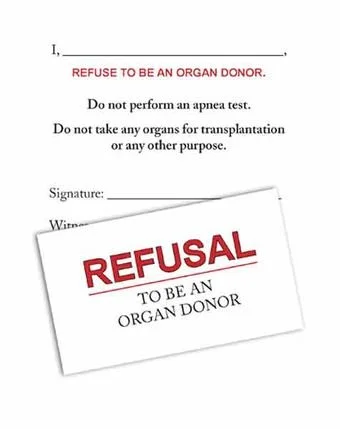
The Uniform Anatomical Gift Act was revised in 2006 and most states have adopted it. Everyone who has not explicitly refused to be an organ donor is now considered a “prospective donor.” This means that, if you are “at or near death,” your hospital must notify an Organ Procurement Organization (OPO). While the OPO searches for a “reasonably available” family member or other person who can legally consent or refuse to donate your organs, the medical team can treat you like a donor, subjecting you to medical procedures—not beneficial to you—solely to make certain your organs are in tip-top condition for the potential recipient.
PROTECT YOURSELF. HLA recommends signing and carrying a “Refusal to be an Organ Donor” wallet card at all times. To request cards, visit humanlife.org or call 651-484-1040.